
To check and refill engine oil
1600 models
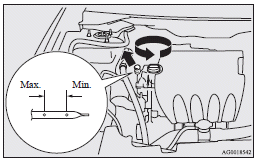
1800 models (petrol-powered vehicles)
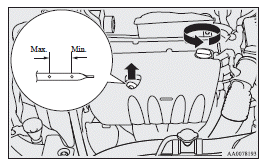
1800 models (diesel-powered vehicles)
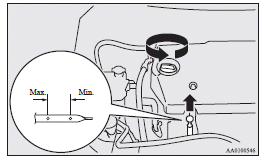
2000 models
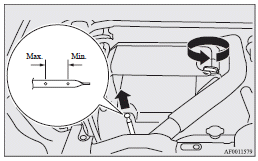
The engine oil used has a significant effect on the engine’s performance, service life and startability.
Be sure to use oil of the recommended quality and appropriate viscosity.
All engines consume a certain amount of oil during normal operation. Therefore, it is important to check the oil level at regular intervals or before starting a long trip.
1. Park the car on a horizontal surface.
2. Switch off the engine.
3. Wait a few minutes.
4. Remove the dipstick and wipe it with a clean cloth.
5. Reinsert the dipstick as far as it goes.
6. Remove the dipstick and read the oil level, which should always be within
the range indicated.
7. If the oil level is below the specified limit, remove the cap located on the
cylinder head cover and add enough oil to raise the level to within the specified
range. Do not overfill to avoid engine damage. Be sure to use the specified engine
oil and do not mix various types of oil.
8. After adding oil, close the cap securely.
9. Confirm the oil level by repeating step 4 to 6.
Use only the recommended oils with an ACEA, API or JASO classification as specified in this manual.
 Caution
► In diesel-powered vehicles, when burning away and removing soot accumulated
in the DPF, fuel can mix with the engine oil and an increase in the engine oil level
may occur. This does not indicate an abnormality.
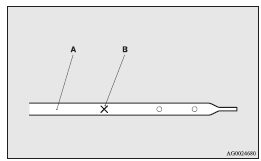
However, if the engine oil level is at or over the “X” mark (B) on the engine oil
dipstick (A), change the engine oil.
 Note
Note
► On vehicles equipped with turbocharger, the engine oil consumption is greatly
influenced by payload, engine speed, etc. Depending on how you drive, it can reach
1.0 lit./1,000 km.
► The engine oil will deteriorate rapidly if the vehicle is subjected to severe
conditions, requiring earlier oil replacement.
Please refer to the maintenance schedule.
► For information on how to dispose of used engine oil, refer to page 05.
See also:
Retracting and extending the outside mirrors
The outside mirror can be folded in towards the side window to prevent damage
when parking in narrow areas.
Caution
► Do not drive the vehicle with the mirror folded in.
The lack of rearwa ...
A/T mode changeover switch (Except for vehicles with Sports mode)
Two drive modes, “AUTO” and “HOLD”, can be selected.
Each time you press the switch, the “AUTO” and “HOLD” modes will switch alternately.
When the “HOLD” mode is selected, the ...
Rear window demister switch
The rear window demister switch can be operated when the engine is running.
Push the switch to turn on the rear window demister.
It will be turned off automatically in about 20 minutes. To turn off ...