
Engine overheating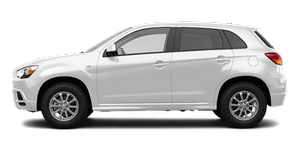
When the engine is overheating, the information screen in the multi-information
display will be interrupted and the engine coolant temperature warning display will
appear. Also  will blink.
If this occurs, take the following corrective measures:
1. Stop the vehicle in a safe place.
2. Check whether steam is coming from the engine compartment.
[If steam does not come from the engine compartment] With the engine still running, raise the bonnet to ventilate the engine compartment.
 NOTE
NOTE
• For vehicles equipped with the Auto Stop &
Go (AS&G) system, press the “Auto Stop &
Go (AS&G) OFF” switch to deactivate the Auto Stop & Go (AS&G) system before stopping the vehicle.
Refer to “To deactivate”.
[If steam is coming from the engine compartment]
Stop the engine, and when the steam stops, raise the bonnet to ventilate the engine compartment.
Restart the engine.
 WARNING
• Do not open the bonnet while steam is coming from the engine compartment. It could cause steam or hot water to spurt out, causing burns. Hot water could spurt out even when there is no steam coming out, and some parts will be very hot. Be very careful when opening the bonnet.
• Be careful of hot steam, which could cause the cap on the engine reserve tank to blow off.
• Do not attempt to remove the radiator cap (petrol-powered vehicles) or reserve tank cap (diesel-powered vehicles) while the engine is hot.
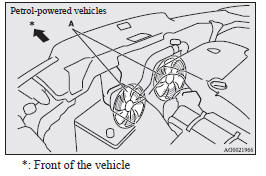
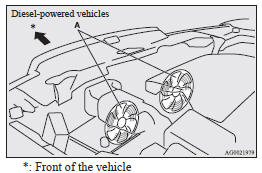
3. Confirm that the cooling fans (A) are turning.
If the fans are not turning, stop the engine immediately and have it checked.
WARNING
• Be careful not to get your hands or clothes caught in the cooling fan.
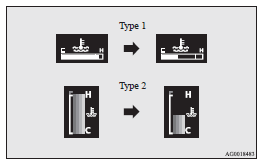
4. When the bar graph in the engine coolant temperature warning display in the multi-information display drops, stop the engine.
5. Check the coolant level in the reserve tank (B).
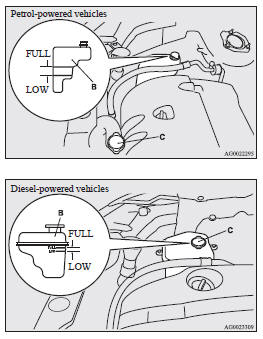
WARNING
• If there is none, make sure that the engine has cooled down before removing the radiator cap (C) (petrol-powered vehicles) or reserve tank cap (C) (diesel-powered vehicles), because hot steam or boiling water otherwise will gush from the filler port and may scald you.
6. Fill the reserve tank with coolant as needed.
(Refer to the “Maintenance” section.)
 CAUTION
• Do not add coolant while the engine is hot. Suddenly adding cold coolant could damage the engine. Wait for the engine to cool down, then add coolant a little at a time.
7. Examine the radiator hoses for coolant leakage and the drive belt for looseness or damage.
If there is anything wrong with the cooling system or drive belt, we recommend you to have it checked and repaired.
See also:
How to use the rear-view camera
When you place the gearshift lever or the selector lever in the “R” position
with the ignition switch in the “ON” position, the view behind the vehicle will
automatically appear on the scr ...
If your vehicle is to be towed by another vehicle
1. Take out the towing hook, wheel nut wrench and jack bar. (Refer to “Tools
and jack”.)
2. Cover the tip of the jack bar with a cloth, then use it to remove the cover
(A) that is located on ...
Error codes (USB memory device)
If an error code appears in the display, take action in accordance with the table
below.
...