
To listen to a tape
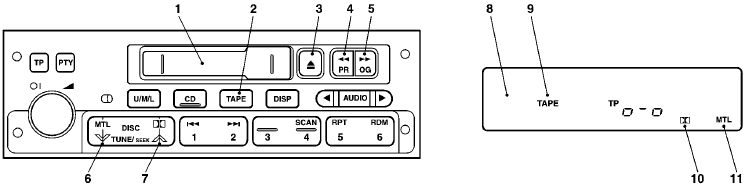
1- Cassette slot
2- TAPE button
3- Cassette eject button
4/5- PROG (Program
selector, Fast-forward/Fast-rewind) buttons
6- MTL (Tape selector) button
7-
 (Dolby noise reduction) button
8-
Tape travel display window
9- TAPE indicator
10-
 (Dolby noise reduction) indicator
11- MTL (Tape selector) indicator
1. After checking to be sure the tape in the cassette is wound tightly, push a cassette straight into the slot; the tape player will automatically start playing. When a cassette is inserted, the tape player will begin playing even if the radio is being used. The tape player will also start playing when the TAPE button (2) is pressed with a tape cassette in the player even if the radio is being used.
2. Press the (Dolby noise reduction)
button (7) when playing Dolby NR encoded tapes. The Dolby noise reduction circuitry
reduces tape hiss. The indicator illuminates when the circuit is activated. Pressing
the (Dolby noise reduction) button
a second time will switch off the Dolby system.
NOTE
Dolby noise reduction is manufactured under licence from Dolby Laboratories Licensing Corporation.
“DOLBY” and the Double-D symbol are trademarks of Dolby Laboratories Licensing Corporation.
3. When listening to a metal or chrome tape, press the MTL button (6). The indicator will illuminate when the button is pressed.
NOTE
Use this button only when listening to a metal or chrome tape.
4. To adjust the volume and tone, refer to the section “How to adjust the volume”,
and “How to adjust the tone” on page 6–5.
5. Press two PROG buttons (4 or 5) simultaneously.
The tape will then run opposite to its current direction, as shown by the display
(8). If the button is not pressed, the tape direction will change automatically
at the end of the tape.
6. Press the Cassette eject button (3); the tape will
automatically stop and the cassette will eject.
7. For information concerning
the handling of tape cassettes, refer to the section “Handling of cassette tapes”
on page 6–27.
See also:
Rear shelf panel
Caution
► Do not place luggage or other items on the rear shelf panel. Any items on
the rear shelf panel would obstruct your rearward view, and they could fly forward
and cause injuries or ...
Economical driving
For economical driving, there are some technical requirements that have to be
met. The prerequisite for low fuel consumption is a properly adjusted engine.
In order to achieve longer life of the ve ...
Cooling
Set the mode selection dial to the “”
position.
Set the air selection switch (A) to the outside position and push the air conditioning
switch (B).
Adjust the temperature by turning the tem ...