
Bending lamps (Adaptive Front lighting System (AFS)) (for vehicles equipped
with high intensity discharge headlamps)
1. When replacing the bulb on the right side of the vehicle, remove the bolt (A) holding down the washer tank spout and move the spout towards the rear of the vehicle.
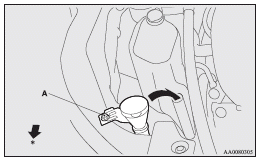
: Front of the vehicle
2. Turn the cap (B) anticlockwise to remove it.
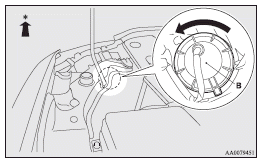
: Front of the vehicle
3. Turn the bulb (C) anticlockwise to remove it.
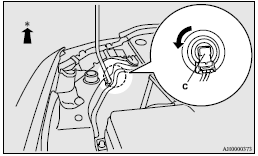
: Front of the vehicle
4. While pressing the tab (D), pull out the bulb (E).
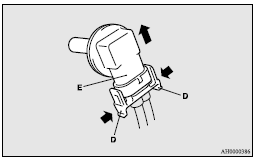
5. To install the bulb, perform the removal steps in reverse.
 Caution
► Handle halogen lamp bulbs with care.
The gas inside halogen lamp bulbs is highly pressurized, so dropping, knocking,
or scratching a halogen lamp bulb can cause it to shatter.
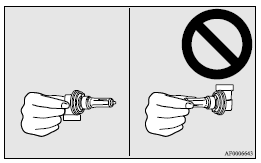
► Never hold the halogen lamp bulb with a bare hand, dirty glove, etc. The oil from
your hand could cause the bulb to break the next time the bending lamps (Adaptive
Front lighting System (AFS)) are operated.
If the glass surface is dirty, it must be cleaned with alcohol, paint thinner, etc., and refit it after drying it thoroughly.
See also:
Vehicles with Twin Clutch SST
...
Changing a fuse
1. Before replacing a fuse, always turn off the electrical circuit concerned
and turn the ignition key to the “LOCK” position. 2. Remove the fuse box cover.
3. Referring to the fuse load cap ...
Heated seats
The heated seats can be operated with the ignition switch in the “ON” position.
Operate the switch as indicated by arrows.
The indication lamp (A) will illuminate while the heater is on.
1 ( ...