
How to change a tyre
Before changing a tyre, first stop your vehicle in a safe, flat location.
1. Park the vehicle on level and stable ground, free of loose pebbles, etc.
2. Set the parking brake firmly.
3. On vehicles with M/T, stop the engine and move the gearshift lever to the
“R” (Reverse) position.
On vehicles with CVT, move the selector lever to the “P” (PARK) position and stop the engine.
4. Turn on the hazard warning flashers and set up a warning triangle, flashing signal lamp, etc., at an adequate distance from the vehicle, and have all your passengers leave the vehicle.
 NOTE
NOTE
• The warning triangle and flashing signal lamp do not come with your vehicle. It is recommended that you keep one in the vehicle for use if needed.
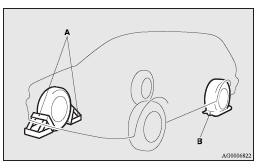
5. To prevent the vehicle from rolling when it is raised on the jack, place chocks or blocks (A) in front of and behind the tyre that is diagonally opposite from the tyre (B) you are changing.
 WARNING
• Be sure to apply chocks or blocks to the correct tyre when jacking up the vehicle.
If the vehicle moves while jacked up, the jack could slip out of position, leading to an accident.
NOTE
• The chocks shown in the illustration do not come with your vehicle. It is recommended that you keep one in the vehicle for use if needed.
• If chocks or blocks are not available, use stones or any other objects that are large enough to hold the wheel in position.
6. Get the jack bar and wheel nut wrench ready.
Refer to “Tools, jack and tyre repair kit”.
See also:
To listen to a CD
1- PWR (On-off switch) 2- U/M/L button 3- CD (CD mode changeover) button
4- Disc loading slot 5- CD eject button 6- DISC (Disc selection) button* 7-
(Track down) button 8- (Track up) button 9- S ...
Spare wheel
Check the air pressure in the spare tyre weekly, making sure it is ready for
emergency use. Maintaining the spare wheel at the highest specified air pressure
will ensure that it can always be us ...
Interrupt display screen (when the ignition switch is “ON”)
Warning display
When there is information to be announced, such as a system fault, a sound is
emitted and the information screen switches to the warning display screen.
Refer to the warning list a ...