
Turbocharger operation
 Caution
► Do not run the engine at high speeds (for example, by revving it or by accelerating
rapidly) immediately after starting it.
► Do not stop the engine immediately after high-speed or uphill driving. First allow
the engine to idle to give the turbocharger a chance to cool down.
Turbocharger
The turbocharger increases engine power by pushing large amounts of air into the engine’s cylinders.
The finned parts inside the turbocharger turn at extremely high speeds and are subjected to extremely high temperatures. They are lubricated and cooled by engine oil. If the engine oil is not replaced at the specified intervals, the bearings may seize or emit abnormal noise.
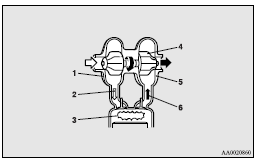
1- Air compressor
2- Compressed air
3- Cylinder
4- Turbo fin
5- Turbine
6- Exhaust gas
See also:
Operation of the Dead Lock System
In a vehicle that has a Dead Lock System, it is possible to set the Dead Lock
System using the remote controller. (Refer to “Dead Lock System”.) ...
Anti-lock brake system (ABS)
The anti-lock brake system (ABS) helps prevent the wheels from locking up when
braking. This helps maintain vehicle drivability and steering wheel handling.
Driving hints
• Always keep a safe di ...
Tachometer
The tachometer indicates the engine speed (r/min).
The tachometer helps you to obtain more economical driving and also warns you
of excessive engine speeds (Red zone).
Caution
► When dri ...