
Cargo loads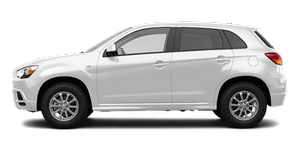
Cargo loads precautions
 CAUTION
• Do not load cargo or luggage higher than the top of the seatback. Be sure that your cargo or luggage cannot move once your vehicle is moving. Having the driver’s vision blocked, and your cargo being thrown inside the cabin if you suddenly have to brake can cause a serious accident or injury.
• Load heavy cargo or luggage in the front of the vehicle. If the load in the back of the vehicle is too heavy, steering may become unstable.
Loading a roof carrier
CAUTION
• Use a roof carrier that properly fits your vehicle. Do not load luggage directly onto the roof. For installation, refer to the instruction manual accompanying the roof carrier.
• When attaching/removing the roof carrier and loading/removing luggage, do not apply excessive pressure on a single point.
Depending on how and where the force is applied, this may cause dents on the vehicle roof.
 NOTE
NOTE
• We recommend you to use a genuine MITSUBISHI roof carrier, since the brackets to be used have a special shape.
For details, we recommend you to consult a MITSUBISHI MOTORS Authorized Service Point.
Roof carrier mounting brackets
When installing the roof carrier, use the brackets (A).
The brackets (A) are located under each cover (B).
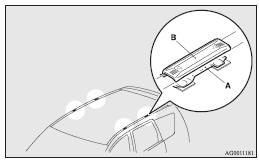
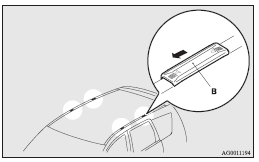
Attaching the roof carrier
Slide each cover (B) towards the front of the vehicle to remove it.
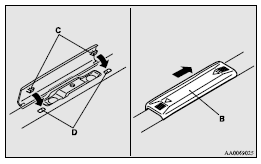
Refitting the covers
1. With each cover, put the tabs (C) on the cover in the holes (D) in the roof.
2. Slide the cover (B) towards the rear of the vehicle to install it.
Roof carrier precaution
CAUTION
• Make sure that the weight of the luggage does not exceed the allowable roof load.
If the allowable roof load is exceeded, this may cause damage to the vehicle.
The roof load is the total allowable load on the roof (the weight of the roof carrier plus the weight of luggage placed on the roof carrier).
For the specific value, refer to “Maximum roof load”.
• When luggage is loaded onto the vehicle, please make sure to drive slowly and avoid excessive manoeuvres such as sudden braking or quick turning.
In addition, place the luggage on the carrier so that its weight is distributed evenly with the heaviest items on the bottom.
Do not load items that are wider than the roof carrier.
The additional weight on the roof could raise the vehicle’s centre of gravity and affect vehicle handling characteristics.
As a result, driving errors or emergency manoeuvres could lead to a loss of control and result in an accident.
• Before driving and after travelling a short distance, always check the load to make sure it is securely fastened to the roof carrier.
Check periodically during your travel that the load remains secure.
NOTE
• To prevent wind noise or reduction in fuel economy, remove the roof carrier
when not in use.
• Remove the roof carrier before using an automatic car wash.
• Be sure that adequate clearance is maintained for raising the tailgate when
installing a roof carrier.
See also:
To find the start of a desired track
The start of each track on a disc can be found by using the
or
button (7 or 8).
Track up:
Press the button (8) the number
of tracks to skip over.
The frequency-display window will display th ...
ASC operation display or ASC OFF display
- ASC operation display/ASC indicator
The display/indicator will blink
when the ASC is operating.
- ASC OFF display/ASC OFF indicator
This display/incicator will turn on
when the ASC is turned o ...
If the vehicle breaks down
If the vehicle breaks down on the road, move it to the shoulder and use the hazard
warning flashers.
If the engine stops/fails
Vehicle operation and control are affected if the engine stops. Befor ...