
Cautions on handling of 4-wheeldrive vehicles
Tyres and wheels
Since the driving torque can be applied to the 4 wheels, the driving performance of the vehicle when operating in 4-wheel drive is greatly affected by the condition of the tyres.
Pay close attention to the tyres.
• Install only the specified tyres on all wheels.
Refer to “Tyres and wheels”.
• Be sure all 4 tyres and wheels are the same size and type.
When it is necessary to replace any of the tyres or wheels, replace all 4 tyres.
• All tyres should be rotated before the wear difference between the front and rear tyres is recognizable.
Good vehicle performance cannot be expected if there is a difference in wear between tyres. Refer to “Tyre rotation”.
• Check the tyre inflation pressure regularly.
 CAUTION
• Always use tyres of the same size, same type, and same brand, and which have no wear differences. Using tyres of different size, type, brands or degree of wear, will increase the differential oil temperature, resulting in possible damage to the driving system. Further, the drive train will be subjected to excessive loading possibly leading to oil leakage, component seizure, or other serious faults.
Towing
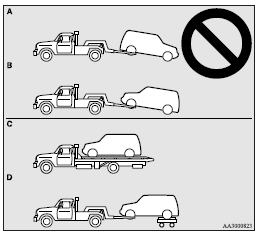
CAUTION
• Do not tow 4-wheel drive vehicles with the front or rear wheels on the ground (Type A or Type B) as illustrated. This could result in damage to the drivetrain, or unstable towing.
If you tow 4-wheel drive vehicles, use Type C or Type D equipment.
• Even in “2WD” drive mode, the vehicle cannot be towed with the front or the rear wheels on the ground.
Jacking up a 4-wheel drive vehicle
 WARNING
• Do not crank the engine while the vehicle is jacked up.
The tyre on the ground may turn and the vehicle may roll off the jack.
Clutch operation
Quick or slight clutch engagement made while the engine is running at high speed will cause damage to the clutch and transmission because the tractive force is very great.
Operate the pedal slowly and positively.
See also:
Fuel consumption
...
Aluminium wheels
1. Remove dirt using a sponge while sprinkling water on the wheel.
2. Use neutral detergent on any dirt that cannot be removed easily with water.
Rinse off the neutral detergent after washing the wh ...
To change the indication on the screen of the inside rear-view mirror
It is possible to turn off the screen of the inside rearview mirror and change
the language of the warning messages on the screen.
To temporarily set the non- display mode
If you press the switc ...