
Twin Clutch SST control mode
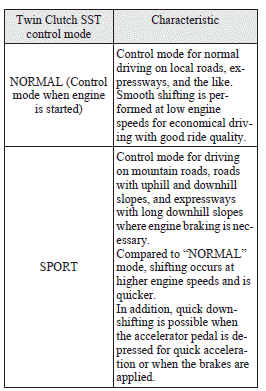
Select the control mode from the following two types to suit the driving conditions.
 Note
Note
► When continuously driving on closed circuit tracks or at other locations where
the engine is operated at high speeds and under a heavy load, the Twin Clutch SST
fluid temperature will have a tendency to rise.
In this case, if the temperature rises too high, the
 warning display will appear on the
information screen in the multi-information display to alert the driver.
warning display will appear on the
information screen in the multi-information display to alert the driver.
If the warning display appears, be
sure to refer to “Warning display” and follow the appropriate measures.
► The Twin Clutch SST control mode can be selected both when “D” range operation
is selected and when manual shifting is selected.
► If you select “SPORT” mode while the engine is cold, the transmission may shift
up at different speeds compared to that when the engine is warm.
This is simply the operation of the control system to warm the engine quickly. It
does not indicate a malfunction.
► For slippery road surfaces, such as roads with accumulated snow, “NORMAL” mode
is recommended for smooth shifting at low engine speeds.
See also:
To temporarily increase or decrease the speed
To temporarily increase the speed
Depress the accelerator pedal as you would normally.
When you release the pedal, you will return to your set speed.
Note
► In some driving conditions, th ...
Spare wheel information
Check the air pressure of the spare tyre frequently and make sure it is ready
for emergency use at any time.
Maintaining the spare wheel at the highest specified air pressure will ensure
that it ...
Anti–freeze
The engine coolant contains an ethylene glycol anti–corrosion agent. The cylinder
head and water pump housing are cast aluminium alloy, and periodic changing of the
engine coolant is necessary t ...