
Seat belts
To protect you and your passengers in the event of an accident, it is the most important that the seat belts are worn correctly when you drive.
The front seat belts have pre–tensioners. These belts are used the same way as conventional seat belts.
Refer to “Seat belt with pre–tensioner mechanism and force–limiter mechanism” on page 3–14.
WARNING
(1) Never wear the shoulder portion of the seat belt under the arm or other
position which is incorrect.
(2) One seat belt should be used by only one person.
Doing otherwise can be dangerous.
(3) The seat belt will provide its wearer with
maximum protection if the seatback recliner is placed in fully upright position.
When the seatback is reclined, there is greater risk that the passenger will slide
under the belt, especially in a forward impact accident, and may be injured by the
belt or by striking the instrument panel or seatbacks.
(4) Seat belts should always
be worn by every adult who drives or rides in this vehicle, and by all children
who are large enough to wear seat belts properly.
(5) Remove any twists when using
the belt.
(6) No modifications or additions should be made by the user which will
either prevent the seat belt adjusting devices from operating to remove slack, or
prevent the seat belt assembly from being adjusted to remove slack.
WARNING
(7) To reduce risk of serious or fatal injury in an accident, including
from a deploying driver air bag, the driver should adjust the driver’s seat to the
rear most position that still allows good visibility and good control of the steering
wheel, the brake and accelerator, and vehicle controls.
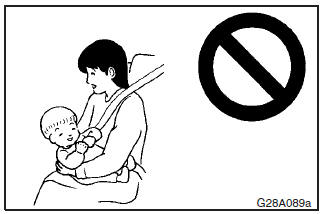
(8) Never hold a child
in your arms or on your lap when riding in this vehicle, even if you are wearing
your seat belt. To do so risks severe or fatal injury to your child in a collision
or sudden stop.
(9) Always adjust the belt to a snug fit.
See also:
Radio control panel and display
1- PWR (On-Off) switch
2- AM/FM (FM/MW/LW selection) button
3- Memory select buttons
4- TUNE switch
5- SEEK (Up-seek) button
6- SEEK (Down-seek) button
7- FM (FM1/FM2/FM3) indicator
8- ST ( ...
Full-time 4WD
Full-time 4WD vehicles are propelled by engine power distributed constantly and
appropriately to all 4 wheels.
Not only does this ensure better handling on dry, paved roads but also permits
bette ...
How to adjust the volume
VOL (Volume control)-2
Turn the knob clockwise to increase the volume.
How to adjust the tone
Press the AUDIO button (5) to select BASS TREBLE FADER BALANCE Audio adjust mode
off.
BASS (Bass t ...