
Headlamps (low beam, except for vehicles with high intensity discharge headlamps)
1. For petrol-powered vehicles equipped with turbocharger, when replacing the bulb on the left side, remove the bolt (A) holding down the relay box and move the relay box towards the rear of the vehicle.
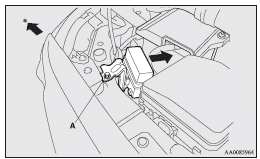
: Front of the vehicle
2. For petrol-powered vehicles equipped with turbocharger, when replacing the bulb on the right side, lift up the engine coolant reservoir (B).
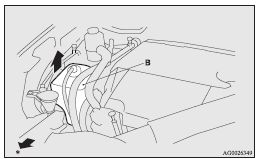
: Front of the vehicle
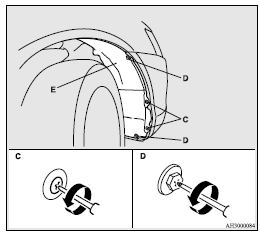
3. When replacing the bulb on the right side of the vehicle in case of diesel-powered vehicles, turn the steering wheel to the left to create enough work space. And then, remove the clips (C) and screws (D) to turn up the cover (E).
4. Turn the bulb (F) anticlockwise, and then remove the headlamp bulb with holder.
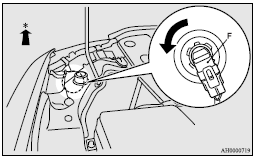
: Front of the vehicle
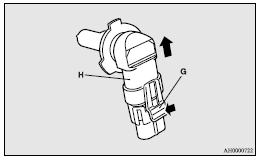
5. While pressing the tab (G), pull out the bulb (H).
6. To install the bulb, perform the removal steps in reverse.
 Caution
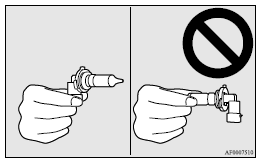
► Handle halogen lamp bulbs with care.
The gas inside halogen lamp bulbs is highly pressurized, so dropping, knocking,
or scratching a halogen lamp bulb can cause it to shatter.
► Never hold the halogen lamp bulb with a bare hand, dirty glove, etc. The oil from
your hand could cause the bulb to break the next time the headlamps are operated.
If the glass surface is dirty, it must be cleaned with alcohol, paint thinner, etc.,
and refit it after drying it thoroughly.
See also:
Side airbag system
The side airbags (A) are contained in the driver and front passenger seatbacks.
The side airbag is designed to inflate only on the side of the vehicle that is
impacted, even with no passenger in th ...
Manual transmission
The shift pattern is shown on the gearshift lever knob. Be sure to always fully
depress the clutch pedal before attempting to shift the lever.
CAUTION
• Do not put the gearshift lever into th ...
If the keyless operation key is not operating properly
Insert the keyless operation key into the key slot in the glove box. Starting
the engine and changing the operation mode should now be possible.
Remove the keyless operation key from the key slot a ...