
Caution for installing the child restraint on vehicles with a front
passenger airbag
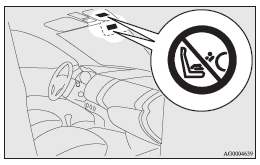
The label shown here is attached on vehicles with a front passenger airbag.
 WARNING
• Extreme Hazard! Do not use a rearward facing child restraint on a seat protected by an airbag in front of it!
 NOTE
NOTE
• The labels may be in different positions depending on the vehicle model.
Use rearward facing child restraints in the rear seat or turn off the front passenger’s airbag ON-OFF switch. (Refer to “To turn an airbag off”.)
WARNING
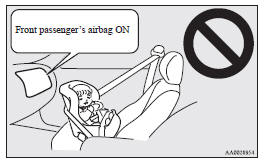
• A REARWARD FACING CHILD RESTRAINT must NOT be used in the front passenger seat if the front passenger’s airbag has not been deactivated.
The force of an inflating airbag could kill or cause serious injuries to the child. A rearward facing child restraint should be used in the rear seat.
• A FORWARD FACING CHILD RESTRAINT should be used in the rear seat whenever possible; if used in the front seat, turn off the front passenger’s airbag ON-OFF switch.
See also:
Replacing tyres and wheels
Caution
► Avoid using different size tyres from the one listed and the combined use
of different types of tyres, as this can affect driving safety.
Refer to “Tyres and wheels”.
► ...
Filling the fuel tank
Warning
► When handling fuel, comply with the safety regulations displayed by garages
and filling stations.
► Before removing the fuel cap, be sure to get rid of your body’s static ...
Hydraulic power steering system (HPS)
The hydraulic power steering system (HPS) uses a hydraulic pressure pump to assist
the turning of the steering wheel.
Caution
► Do not leave the steering wheel turned all the way in one dir ...