
Infants and small children
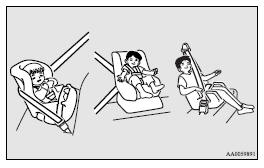
When transporting infants and small children in your vehicle, follow the instruction given below.
Instruction:
• For small infants, an infant carrier should be used. For small children whose height when seated allows the shoulder belt to lie in contact with the face or the throat, a child seat should be used.
• The child restraint system should be appropriate for the child’s weight and height and properly fit in the vehicle. For a higher degree of safety: THE CHILD RESTRAINT SYSTEM SHOULD BE INSTALLED IN THE REAR SEAT.
• Before purchasing a child restraint system, try installing it in the rear seat to make sure there is a good fit. Because of the location of the seat belt buckles and the shape of the seat cushion, it may be difficult to securely install some manufacturer’s child restraint systems.
If the child restraint system can be pulled forward or to either side easily on the seat cushion after the seat belt has been tightened, choose another manufacturer’s child restraint system.
 WARNING
• When installing a child restraint system, refer to the instructions provided by the manufacturer of the restraint system. Failure to do so can result in severe or fatal injury to the child.
• After installation, push and pull the child restraint system back and forth, and side to side, to see that it is properly secured.
If the child restraint system is not installed securely, it may cause injury to the child or other occupants in the case of accident or sudden stops.
• When the child restraint system is not in use, keep your child restraint system secured with the seat belt or remove it from the vehicle in order to prevent it from being thrown around inside the vehicle during an accident.
 NOTE
NOTE
• Depending on the seating position in the vehicle and the child restraint system that you have, the child restraint can be attached using one of the following two locations:
• To the lower anchorage in the rear seat ONLY if the child restraint has ISOFIX
mountings (See page 2-18).
• To the seat belt (See pages 2-10, 2-23).
See also:
Stability control function
The stability control function is designed to help the driver maintain control
of the vehicle on slippery roads or during rapid steering manoeuvres. It works by
controlling the engine output and b ...
New language
Fittingly, MMC's complete family of Passenger Vehicles / Crossovers / SUVs
will also see a gradual transition to a re-focused design language, as seen with
the all-new Mitsubishi Outlander. While ...
Headlamps
Note
► Do not leave the lamps on for a long time while the engine is stationary (not
running).
A rundown battery could result.
► When it rains, or when the vehicle has been washed, t ...