
Turbocharger operation
 CAUTION
• Do not run the engine at high speeds (for example, by revving it or by accelerating rapidly) immediately after starting it.
• Do not stop the engine immediately after high-speed or uphill driving. First allow the engine to idle to give the turbocharger a chance to cool down.
Turbocharger
The turbocharger increases engine power by pushing large amounts of air into the engine’s cylinders.
The finned parts inside the turbocharger turn at extremely high speeds and are subjected to extremely high temperatures. They are lubricated and cooled by engine oil. If the engine oil is not replaced at the specified intervals, the bearings may seize or emit abnormal noise.
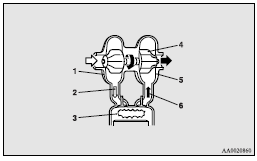
1- Air compressor
2- Compressed air
3- Cylinder
4- Turbo fin
5- Turbine
6- Exhaust gas
See also:
Keyless entry system*
Press the remote control switch, and all doors and the boot lid (or tailgate)
will be locked or unlocked as desired. Pressing the LOCK switch (1) or UNLOCK switch
(2) will turn on the indicator ...
Charge warning lamp
This lamp illuminates when the ignition switch is turned to the “ON” position,
and goes off after the engine has started.
A warning is also displayed on the multiinformation display.
Cautio ...
ACD control mode display
Example: “TARMAC” mode is selected.
The currently selected control mode is displayed on the multi-information display.
In addition, when the control mode is changed, the selected mode appears ...