
Engine oil
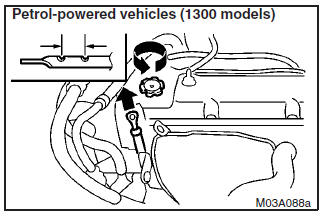
The engine oil used has a significant effect on the engine’s performance, service life and startability. Be sure to use oil of the recommended quality and appropriate viscosity. All engines consume a certain amount of oil during normal operation (See note below). Therefore, it is important to check the oil at regular intervals or before starting a long journey.
da88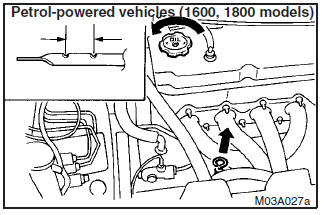
This check must be carried out with the vehicle on a flat level surface with the engine at normal operating temperature, but NOT running. If the engine has been running, wait for a few minutes to allow the engine oil to return to the oil pan to ensure an accurate measurement.
Remove the dipstick and wipe it with a clean cloth, re-insert the dipstick as far as it will go. Remove the dipstick and check the oil level. This should always be within the range as indicated.
If the oil level is below the specified limit, remove the filler cap and add oil. Then recheck the level. When satisfied that the level is correct, refit the oil filler cap making sure that it is securely fitted.
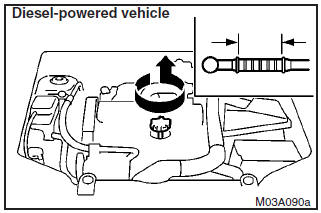
Use only the recommended oils with an API or ACEA classification as specified in this manual.
NOTE
(1) Engine oil consumption is greatly influenced by payload, engine speed,
etc. It may reach 1.0 lit./1,000 km depending on style of driving.
(2) The engine
oil will deteriorate rapidly if the vehicle is subjected to severe conditions (for
example, repeated operation on rough roads, in mountainous regions, on roads with
many uphill and downhill gradients, or over short distances). Consequently, the
oil will require earlier replacement.
(3) For handling of used engine oils, refer
to page 1–11.
See also:
Useful voice commands
Help function
The Bluetooth® 2.0 interface is equipped with a help function.
If you say “Help” when the system is waiting for a voice command input, the system
will tell you a list of the com ...
Towing the vehicle by a tow truck
Caution
► This vehicle must not be towed by a tow truck using sling lift type equipment
(Type A) as illustrated. Using a sling lift will damage the bumper and front end.
► Do not tow ...
Electric power steering system (EPS)
The electric power steering system (EPS) uses an electric motor to assist the
turning of the steering wheel.
Note
► During repeated full-lock turning of the steering wheel (for example, whi ...