
The front airbags and driver’s knee airbag ARE DESIGNED TO DEPLOY when…
The front airbags and driver’s knee airbag are designed to deploy when the vehicle suffers a moderate- to-severe frontal impact. A typical condition is shown in the illustration.
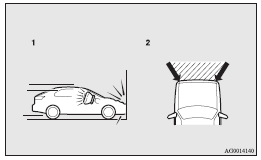
1- Head-on collision with a solid wall at a speed of approximately 25 km/h (16
mph) or higher
2- Moderate-to-severe frontal impact within the shaded area between the arrows
The front airbags and driver’s knee airbag will deploy if the severity of the impact is above the designed threshold level, comparable to an approximately 25 km/h (16 mph) collision when impacting straight into a solid wall that does not move or deform.
If the severity of the impact is below the above threshold level, the front airbags and driver’s knee airbag may not deploy. However, this threshold speed will be considerably higher if the vehicle strikes an object that absorbs the impact by either deforming or moving (for example, another stationary vehicle, pole or a guard rail).
Because frontal collisions can easily move you out of position, it is important to always properly wear your seat belts. Your seat belts will help keep you in a safe distance from the steering wheel and instrument panel during the initial stages of airbag deployment.
The initial stage of airbag inflation is the most forceful, and can possibly cause serious or fatal injuries. Moreover, the seat belts in your vehicle are your primary means of protection in a collision.
The SRS airbags are designed to provide additional protection. Therefore, for your safety and the safety of all occupants, be sure to always properly wear your seat belts.
See also:
Error codes
Vehicles with LW/MW/FM digital tuning radio with CD player/CD changer
If an error code (1) appears in the display, take action in accordance with the
table below.
...
Installation of accessories
Before fitting any accessories, please consult your authorized MITSUBISHI dealer.
(1) The installation of accessories, optional parts, etc., should only be carried
out within the limits prescribed ...
Tools and jack
The storage location of the tools and jack should be remembered in case of an
emergency.
Location
1- Tools 2- Jack
Tools
1- Tool bag 2- Wheel nut wrench 3- Bar
Jack
1- To remove
Turn th ...