
Not Too Quick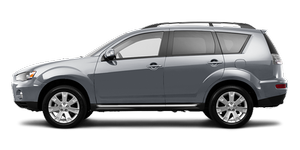
The four-cylinder provides adequate, if noisy, power. A continuously variable automatic transmission is standard; it's not the quickest responder around town, taking its time to gin up the proper revs for sprightly acceleration. On the highway, though, it seems to find 4,000 or 5,000 rpm — where passing power is, well, passable — without too much delay. Dropping my test car's all-wheel drive and optional third-row seat would shave a couple hundred pounds, which is likely enough weight to improve get-up-and-go noticeably. For a 168-horsepower engine, I can't ask for much more.
I can, however, ask for more from the optional 220-hp V-6. It's stronger, to be sure, but it doesn't transform the Outlander into the sort of vivacious performer that the RAV4's V-6 and the Subaru Forester's turbocharged four-cylinder do. The best punch comes at higher engine speeds, which is when the Outlander hustles. Starting out, however, there are few signs of the extra power. Part of that is due to the transmission that's mated to the V-6: a six-speed automatic that isn't much more responsive than the CVT. Upshifts come quickly, but kickdown takes time. Hit the gas pedal coming out of a corner, and you might find the transmission has you in too high a gear, leaving little power to get back up to speed. Both transmissions include a manual mode — the CVT, though technically gearless, simulates six ratios — so it is possible to micromanage your gear selection.
However you slice it, Mitsubishi doesn't have an onramp-charger in the Outlander, which wouldn't be a problem if there were an accompanying gas mileage benefit, but there isn't. The EPA gives it a combined estimate of 20 mpg with front-wheel drive and a V-6. That's a tick behind the same configurations for the RAV4 (22 mpg) and Ford Escape (21 mpg), so unless you intend to tow — the V-6 raises maximum trailer capacity to 3,500 pounds, from 1,500 pounds with the four-cylinder — go with the four. It gives up some oomph but gets 22 mpg overall with either driveline, a rating that comes closer to matching competing four-cylinder models.
See also:
Information screen (when the ignition switch is “OFF“)
Each time you lightly press the multi-information meter switch, the display screen
switches in the following order.
1- Odometer (Type 1)/Tripmeter
2- Odometer (Type 1)/Tripmeter
3- Service re ...
Door ajar warning display screen (when the ignition switch is “OFF”)
If any of the doors or the rear hatch is not completely closed, this displays
the open door or rear hatch.
1- Doors and rear hatch are closed
2- Doors or rear hatch is open ...
Fuel selection
For the petrol-powered vehicles with turbocharger, your engine is designed to
provide satisfactory performance by using unleaded petrol octane number 98 RON or
higher. In order to maintain engin ...