
But Still Fun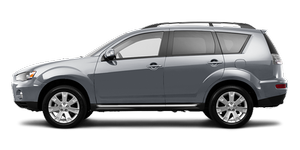
Green-light power isn't the only ingredient in driving fun — just test a car like the non-turbo Mini Cooper or even Mitsubishi's base Lancer. The Outlander is fun in the same kind of way: The steering wheel requires medium effort to turn at low speeds but yields impressive turn-in precision on curvier stretches, and the nose goes right where you point it, with no vague intermediary motions. On the highway, however, the wheel loosens up and feels a bit too twitchy when pointed straight ahead.
Body roll is well-controlled for a crossover, and the four-wheel-disc antilock brakes exhibit a linear, carlike response. The prior-generation Forester comes to mind as comparably agile; its softer successor falls a bit short.
Even with the SE's 18-inch wheels (versus 16-inchers in the ES), wind and road noise remain controlled at highway speeds. The suspension, however, lacks composure. All three trim levels share the same tuning, and it chatters a lot over potholes and expansion joints. It doesn't do a great job isolating the bad stuff, with noticeable reverberation after major bumps. There are worse examples in this crowd — the RAV4's optional sport-tuned suspension comes to mind — and the Outlander's setup never feels uncomfortably brittle, but it could stand to attend finishing school.
See also:
System preparation mode (approx. 20 seconds)
(The buzzer sounds intermittently and the security indicator (A) blinks.)
The system preparation time extends from the point at which all of the doors
and rear hatch are locked by pressing the LO ...
Headlamps
Unhook the spring which secures the bulb, and then remove the bulb.
CAUTION
Never hold the halogen lamp bulb with a bare hand, dirty glove, etc. The
oil from your hand could cause the bulb to ...
Tips for starting
► Do not operate the starter motor continuously longer than 10 seconds; doing
so could run down the battery. If the engine does not start, turn the ignition switch
back to “LOCK”, wait a ...