
Seat belts
To protect you and your passengers in the event of an accident, it is most important that the seat belts be worn correctly while driving.
The front seat belts have a pretensioner system.
These belts are used the same way as a conventional seat belt.
Refer to “Seat belt pretensioner system and force limiter system”.
 WARNING
• Always place the shoulder belt over your shoulder and across your chest. Never put it behind you or under your arm.
• One seat belt should be used by only one person. Doing otherwise can be dangerous.
• The seat belt will provide its wearer with maximum protection if the recliner seatback is placed in fully upright position.
When the seatback is reclined, there is greater risk that the passenger will slide under the belt, especially in a forward impact accident, and may be injured by the belt or by striking the instrument panel or seatbacks.
• Seat belts should always be worn by every adult who drives or rides in this vehicle, and by all children who are tall enough to wear seat belts properly.
Other children should always use proper child restraint systems.
• Remove any twists when using the belt.
• No modifications or additions should be made by the user which will either prevent the seat belt adjusting devices from operating to remove slack, or prevent the seat belt assembly from being adjusted to remove slack.
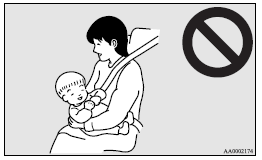
• Never hold a child in your arms or on your lap when riding in this vehicle, even if you are wearing your seat belt. To do so risks severe or fatal injury to the child in a collision or sudden stop.
• Always adjust the belt to a snug fit.
• Always wear the lap portion of the belt over your hips.
See also:
Active Stability Control (ASC) OFF display screen*
This is displayed when the Active Stability Control (ASC) is turned off with
the ASC OFF switch.
If there is a fault with the ASC, the ASC OFF display is shown.
Refer to ““ASC OFF” switchâ ...
To adjust the vertical mirror position
It is possible to move the mirror up and down to adjust its position.
To adjust the mirror position
It is possible to move the mirror up/down and left/ right to adjust its position.
...
Vehicle equipped with steel wheels
Tighten the wheel nuts (tapered nuts) until the tapered parts of the wheel nuts
make light contact with the seats of the wheel holes and the wheel is not loose.
With a spare wheel, tighten the whee ...